A short history
Honey rakija, honey liqueur, medena rakija or medovača: you have surely heard each of these names, and probably tasted it too. It is a traditional drink of the old Slavs; something similar was made even in Roman times, and it is produced in almost every country in the world.
Many people wrongly call honey rakija “medovina”. Medovina is mead, a wine made from honey or with added honey; medovača is honey rakija; and medica is a drink on an alcoholic base (šljivovica, dunjevača, lozovača, wine distillate and the like) enriched with honey. Depending on the amount, quality and kind of honey added to the base, it takes on a beautiful colour and a gentle scent of honey.
Medovača, honey rakija
We will not write about where honey comes from or what kinds exist; only about medovača and how it is made.
The honey is first dissolved in distilled water of a set temperature and volume. Meadow and linden honey are often crystallised, so the water has to be heated to 50 °C and stirred hard; acacia honey is liquid, and 27 °C, the fermentation temperature, is enough. The solutions are then ready to ferment.
Fermenting the honey
Fermentation runs at 27 °C, and the fall in dry matter is followed with a refractometer, every other day at first and later once a week. Wine yeasts and pectolytic enzymes are needed. It can last several months; when it is over, the fermented batches are ready to distil.
Distilling the fermented honey
For good medovača the honey must be sound. Knowing the process, preparing and fermenting the honey properly, not waiting long to distil, and storing and caring for the distillate properly all matter a great deal.
The fermented honey is distilled in Charentais-type batch stills, slowly and evenly, without separating the heads. The result, at about 30% vol on average, is raw soft medovača. It is redistilled in the same kind of still, now always separating the heads (1%). The heart is collected in a special clean vessel until the average strength is 58–60% vol, and the tails until the end of distillation.
For the next 20 days the distillate is kept in an inert vessel (glass, stainless steel or ceramics), away from light, to harmonise. Over the following months its strength is lowered gradually, in several steps, with distilled or better still demineralised water, to 40–45% vol. It improves further by maturing in an oak cask for at least two years, in a room with no other rakija or food, so that it does not take on foreign aromas.
The finished rakija is usually bottled in fine souvenir bottles. Darker honeys give a darker colour, lighter ones such as acacia a lighter one. Despite its strength, medovača is very smooth, and it is often served chilled, as an aperitif.
An Akademska medovača?
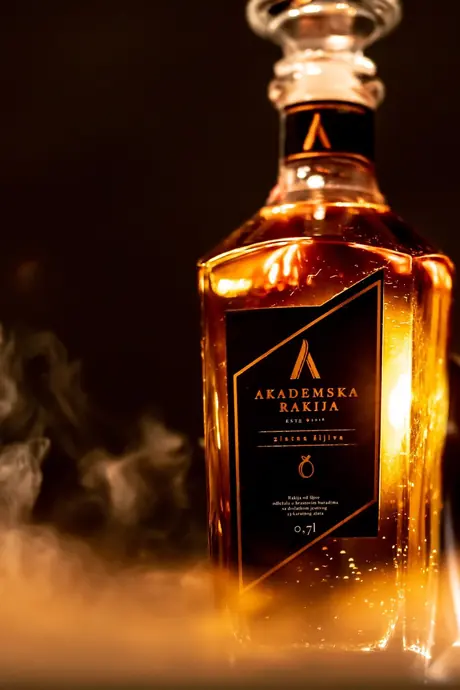
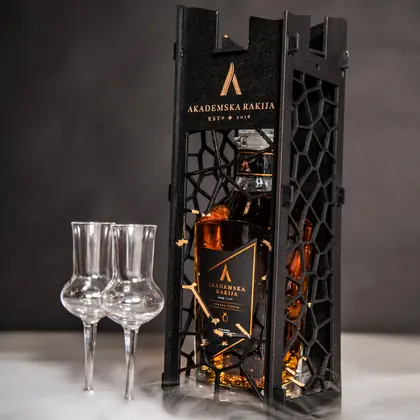
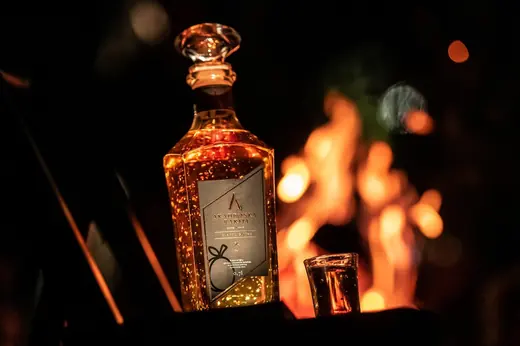
We hope you enjoyed this slightly more theoretical piece; medovača deserves it, having been drunk throughout human history. And how does an Akademska medovača sound? To us, very good. Imagine the bottle in the picture below with medovača in it. It will have to wait a little longer, though: tell us on Facebook or Instagram whether we should set off on that adventure.