Šljivovica
Šljivovica is a stone-fruit rakija made by distilling and/or rectifying only fully fermented plums of the species Prunus domestica, to no more than 86% vol of ethanol, so that its aroma comes only from the distilled fruit.
The plum
The plum is a fruit of the northern hemisphere. Most of it is grown in Europe (62%), then Asia (21%) and North America (12.5%). The largest producers are the former USSR, then China, the former Yugoslavia, Romania, Germany, Hungary, France, Turkey and Italy.
Among fruit trees the plum is ninth in the world by production, but in the former Yugoslavia, and in Serbia above all, it is first. It has been grown in the Balkans for centuries, mostly in Serbia and Bosnia, and does very well in the hills and mountains. Depending on the variety it ripens from mid-June to mid-October and is eaten fresh and dried, much of it exported.
Plums are made into a whole range of sweet products, but most of the harvest in Serbia, more than 90%, goes into šljivovica and plum prepečenica, our national spirit.
Kajsijevača
Kajsijevača is a fruit rakija made by distilling and/or rectifying the fermented mash of fresh apricots or apricot must, with or without the stones, to no more than 86% vol, so that its aroma comes only from the distilled fruit.
The apricot
The apricot (Prunus armeniaca) comes from north-eastern China, on the border with Russia and Mongolia. Today it grows mostly in the northern parts of the Near and Central East, at 800–2,000 metres, where a climate with small swings of temperature gives regular, high yields. Lower down, with winter swings and early spring frosts, its yields vary.
The varieties grown in southern Europe and here ripen within a short window of 25–30 days. Most are not hardy enough against frost and sudden die-back of the tree, apoplexy, which is common where late winter and early spring are changeable, as they often are in our orchards. Research suggests the variety and its genes are among the main causes, and that it strikes varieties with a shorter dormancy more often, which is why growers now favour varieties with a longer one.
Breskovača
Breskovača is a fruit rakija made by distilling and/or rectifying the fermented mash of fresh peaches or peach must, with or without the stones, to no more than 86% vol, with its aroma only from the distilled fruit.
The peach
Peaches were grown in China 2,000 years before the Romans knew them; commercial growing began in the 19th century. Today the peach is one of the most widespread fruit trees, prized for fruit that in many ways surpasses other continental fruit. It grows fast, bears early and reaches its full yield in the sixth year. The largest producers are the USA, France, Spain, Italy, Greece, China, Japan and Argentina.
Its share in Serbian orcharding has grown considerably in recent decades; the main areas are Smederevo and the Danube region, Niš, Leskovac, Čačak, the wider Belgrade area, Mladenovac, Bela Crkva, Subotica, Novi Sad, Irig and Sremska Mitrovica.
Višnjevača
Višnjevača is a fruit rakija made by distilling and/or rectifying the fermented mash of fresh sour cherries or their must, with or without the stones, to no more than 86% vol, its aroma only from the distilled fruit.
The sour cherry is thought to come from Asia Minor and spread across the world together with the sweet cherry. It asks little, bears early and regularly, and resists disease and pests fairly well. With about 10,500,000 trees it is third in Serbian orcharding, after the plum and the apple; Serbia grows about 90,000 tonnes a year, about ten times more than fifty years ago, some 14% of world and 27% of European production, mostly around Smederevo, the Danube region, Niš, Prokuplje and in Vojvodina.
Sour cherries contain 6.5–14% sugar, about 10% on average. Like sweet cherries they hold little pectin, so rakija from them has less methanol.
Rakija with gold
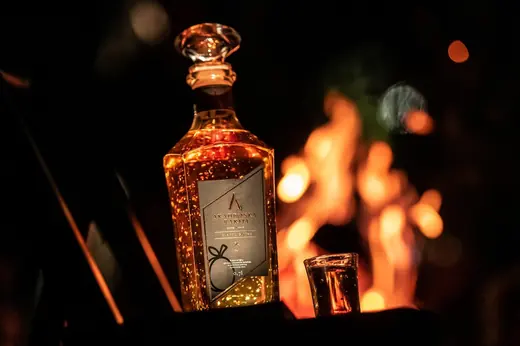
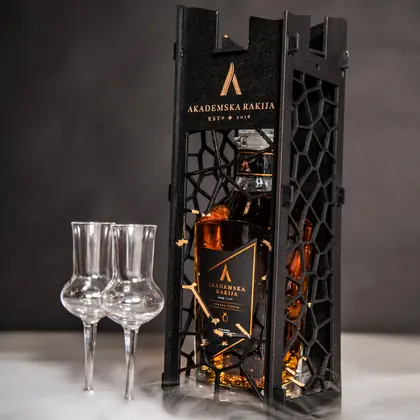
Our Zlatna šljiva is bottled with flakes of 23-carat gold. It comes from a careful choice of the best plums of our native varieties: a blend of Požegača, Čačanska rodna, Čačanska lepotica and the native Moravka, with an intense barrique taste and aroma and notes of vanilla and dried plum from the oak cask.