Reading the title you probably wondered whether this is even possible. Rakija from tropical, citrus and exotic fruit is not usual in Serbia or the former Yugoslavia, but the richness of these fruits in aroma gives great scope for fine rakija. They make delicacy spirits possible, and Akademska rakija has made one. All the technological steps are the same as for ordinary fruit rakija.
Some things need attention. Citrus fruit holds a lot of essential oils; hard parts of the fruit, such as the skin of pineapple, banana, pitaya or pomegranate, and the stones or seeds of avocado, papaya and the like, must be dealt with. Some fruits, such as mango, pitaya, rambutan, pomegranate or banana, give a good yield of alcohol; others, such as papaya, coconut or avocado, give only a modest one.
These distillates rest only in inert vessels such as stainless steel, glass or ceramics. That is crucial, because their primary aromatic compounds do not go with the compounds of an oak vessel.
They are diluted to a drinking strength of 40–45% vol and are best served at 10–12 °C. The fruits most used are lemon, orange, grapefruit, papaya, banana, pineapple, avocado, pitaya, rambutan and others.
Pineapple rakija: the Akademska standard
When you hear Akademska rakija, you may first think of our premium rakija with gold, Zlatna šljiva or Zlatna dunja. That is what we are known for. Encouraged by it, we listened to your wishes and experimented a little. We tried, and we succeeded: we made our own rakija from exotic fruit, Akademski Ananas, pineapple rakija.
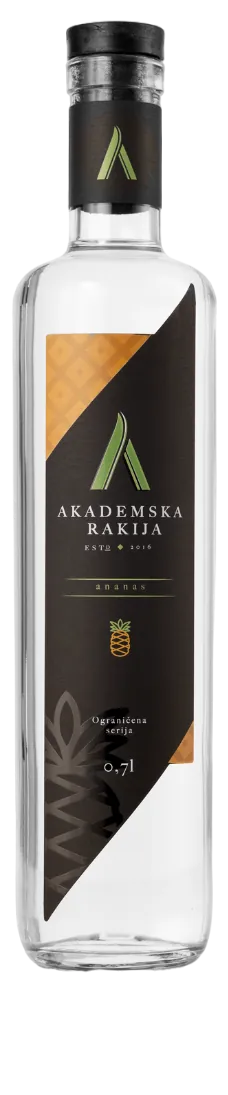
A one-of-a-kind drink that leaves no one indifferent. It is made the same way as Serbian rakijas, so it can be called ananasovača. We use only pineapple, blended into a pure fruit purée after removing every part not normally eaten, the outer skin and the crown. The rest is magic.
Akademski Ananas has a fresh citrus scent and a taste that can fool you into thinking it has less alcohol than it really does.