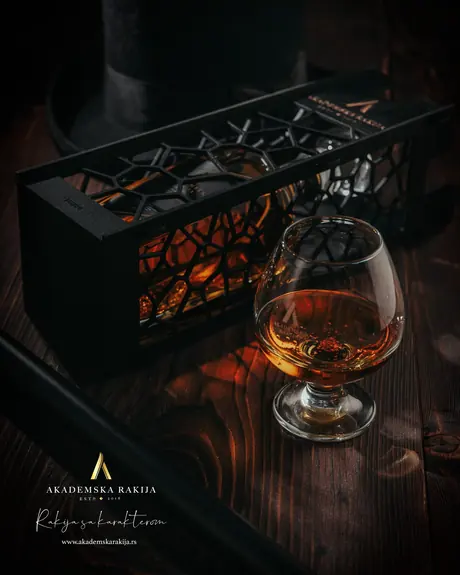
Many of our customers want to know why our gift set holds this particular rakija glass. Here is the answer.
There are several main kinds of drinking glass, each shaped to complement the wine or spirit it is meant for; the thinner and more elegant the glass, the better the drink looks in it. Most households have glasses for white and red wine.
Red wine glasses
Larger, with a bulging, tulip-shaped bowl that narrows at the top. The big volume lets the wine meet oxygen and release its aromas.
White wine glasses
Smaller, with a longer stem: white wine does not need contact with oxygen, hence the difference.
Champagne glasses
Champagne is drunk from tall, thin, conical glasses that let bubbles form quickly and evenly.
Beer glasses
Many do not tell a tankard from an ordinary beer glass. Neither changes the quality of the beer, but with half a litre of beer weighing about 450 g, a heavy glass held by a firm handle is less likely to slip.
You have surely heard of the old Serbian custom of drinking rakija in one go from small glasses, the čokanjčići.
The čokanj
It was used to serve rakija at home and in many kafanas. In the 1960s the Yugoslav authorities declared it unfit for use for reasons of hygiene; today it is mostly a souvenir.
As rakija-making shifts from quantity to quality, science built on good traditional foundations is shaping new rules and styles of drinking rakija, to get the most out of the aromas it so generously offers. Rakija drinking is returning to the style it had at the courts of the Serbian nobility. Like many modern distillers, we hold that every top-quality spirit, rakija, cognac or whisky, is best drunk from wider glasses of larger volume.
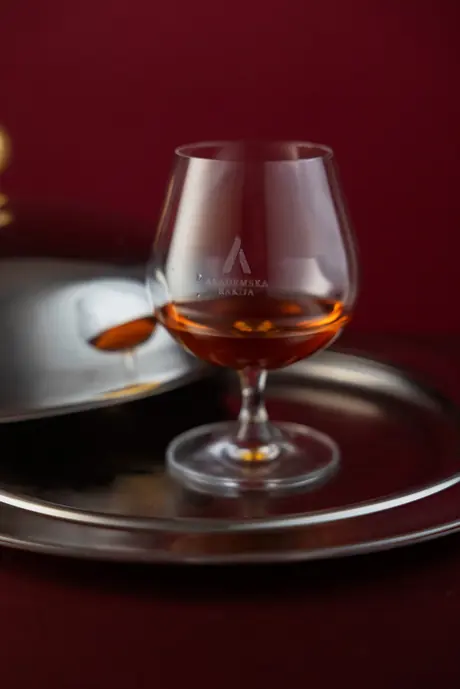
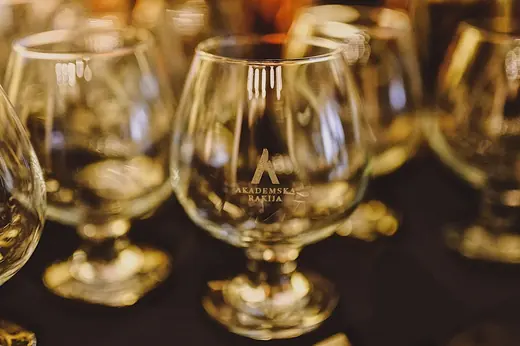
Cognac glasses
These are tulip-shaped glasses. We serve rakija at room temperature (never cold) to enjoy all the richness of this traditional Serbian drink. Before the first sip we swirl the glass: in contact with oxygen the rakija breathes and releases its finest aromas. Then we drink it slowly, sip by sip, to enjoy those aromas fully.
Watch the “tears” on the wall of the glass: the thicker the tear and the more slowly it slides, the older the rakija. Hold the glass up to the light and you will see the golden-yellow tones it took on in the oak cask. The glass narrows at the top, which concentrates the aromas at the tip of the nose so that we sense them perfectly.
We also hope that Serbian šljivovica will soon have a glass of its own; work on one is well under way.
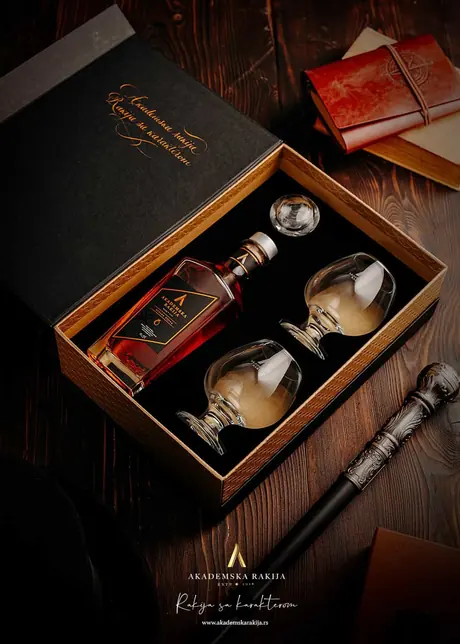
We hope this brings you a little closer to how we enjoy rakija. If you have not yet tried our Akademska šljiva or dunja, you can order them in our shop and taste the real thing. What else is there to say but živeli!